OPINION: Outdated Data, Unintended Damage — Ottawa’s Fishery Closures Miss the Mark for All of BC
Across British Columbia, people are losing confidence that decisions about our land and water are being made with current science and local knowledge in mind. Across BC in our forests, on our farms, and along our coasts the pattern is the same: Ottawa and Victoria make sweeping decisions from behind a desk, while rural and coastal communities live with the fallout.
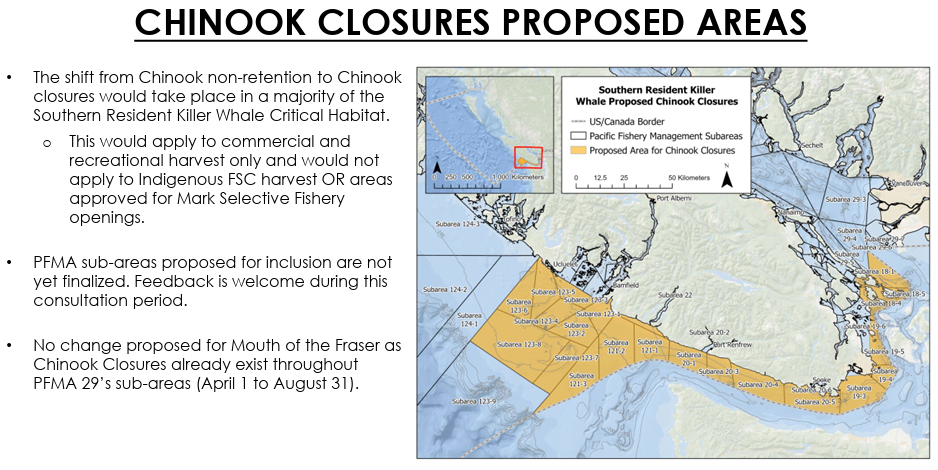
The latest example comes from Vancouver Island’s west coast, where the federal government is proposing new sport and commercial salmon fishing closures in the name of protecting the Southern Resident Killer Whales. These whales are an iconic species that deserve every effort toward recovery — but the science being used to justify further restrictions is years out of date.
According to the State of the Salmon 2025 report, Chinook salmon stocks on the west coast of Vancouver Island have rebounded significantly. Escapement counts in the Nootka, Clayoquot, and Barkley Sound systems show multi-year increases, supported by improved ocean conditions and habitat restoration. Even Fisheries and Oceans Canada’s own data confirms stronger recruitment and reduced exploitation rates across key Chinook populations.
In plain terms — the salmon are back. Yet DFO continues to act as though we are in a state of emergency.
The Department’s September 2025 consultation deck proposes to extend and expand closures in areas such as Swiftsure Bank and the Juan de Fuca Strait, zones that form the backbone of British Columbia’s west-coast recreational and commercial fishery. These are the very waters that sustain communities like Port Renfrew, Sooke, and Ucluelet — towns where tourism, guiding, and small-boat fishing are not just businesses but lifelines.
At a recent meeting in Duncan, fishers packed a hall to plead for common sense. As local charter operator Tristan McMillan put it, “To shut a fishery down when we’re getting such a good dollar per pound on a sustainable fishery makes absolutely no sense.” They’re right. Even DFO acknowledges in its own documents that the incremental benefit of further closures “may be limited.” So why proceed with measures that could eliminate livelihoods for minimal ecological gain?
This is not an isolated issue. It is part of a growing disconnect between data and decision-making in resource management across BC. Whether it’s fish, forests, or water, too many policies are being advanced on precaution rather than precision. Communities are told to trust the process — even when the process ignores local observations, current monitoring data, and the economic realities of rural life.
Balanced conservation requires recognizing success. The recovery of west-coast Chinook stocks is a good-news story that should inform, not be ignored by, federal management. Likewise, addressing predation by seals and sea lions — a concern raised repeatedly by coastal First Nations and fishers — must be part of a holistic approach if we are serious about protecting both salmon and the whales that depend on them.
Protecting the Southern Resident Killer Whales and protecting the people who live along this coast are not opposing goals. But when government decisions rely on outdated evidence, communities lose faith in the very science that conservation depends on.
The Conservative Party of BC believes that British Columbians deserve transparent, data-driven management of our natural resources. That means using current escapement and abundance data, engaging with local and Indigenous knowledge, and balancing environmental outcomes with community sustainability.
The strength of British Columbia has always come from its connection to the land and water — from loggers in the Interior to fishers on the coast. Good stewardship doesn’t mean locking people out of their livelihoods. It means ensuring that people and nature can thrive together.
Because when governments ignore new data and the voices of those closest to the resource, they’re not protecting ecosystems — they’re undermining them.
Submitted by
Donegal Wilson, MLA Boundary-Similkameen and Critic for Water, Lands, Resource Stewardship and Wildlife
Ian Paton, MLA Delta South and Critic for Agriculture and Food
Claire Rattee, MLA Skeena and Critic for Mental Health & Addictions
