Forestry Workers Need Jobs, Not Transition Teams
Another mill closure. More curtailment announcements. More forestry workers and families wondering whether their jobs will be next.
And once again, government is talking about transition.
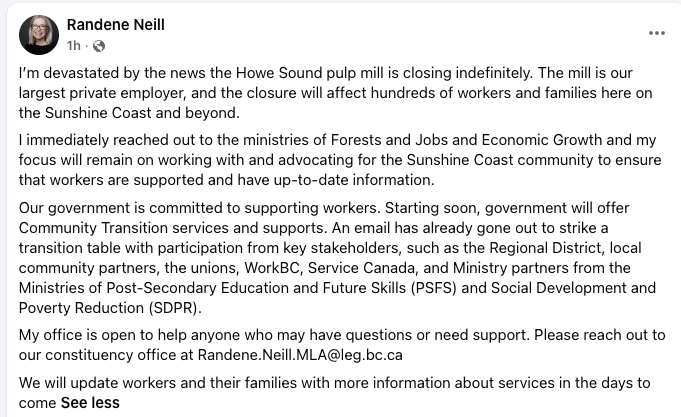
I understand why transition supports exist. When a mill closes, workers need help. Families need support. Communities need government at the table. But a transition team is a net we put underneath people after they have already lost their jobs. At some point, we have to ask a much more important question:
What is government doing to stop them from falling in the first place?
British Columbia does not need a better system for managing the decline of forestry. We need a government prepared to use every tool available to keep affordable, economic fibre flowing to B.C. mills and keep forestry workers working.
This is not a new problem.
For years, mills across this province have closed, curtailed shifts or reduced production. We have watched thousands of forestry jobs disappear. Every closure ripples far beyond the people working inside the mill. It hits logging contractors, truck drivers, equipment dealers, mechanics and small businesses. It affects municipal tax bases and the ability of rural communities to support recreation facilities, infrastructure and local services.
I have spent considerable time talking to people throughout the forestry sector, touring operations and raising these issues in the Legislature. The message is remarkably consistent: mills cannot operate without a predictable and economically viable supply of fibre.
There are certainly pressures outside government's control. Lumber markets change. Tariffs hurt. Wildfires and drought affect operations.
But government cannot point to the things it does not control while ignoring the things it does. Government controls the regulatory environment. It controls permitting processes on Crown land. It controls BC Timber Sales. It controls red tape that drives up costs. It influences how quickly fibre gets from an approved plan to an operating cutblock and ultimately to a mill.
We need to be looking at every one of those levers and how do we manage our forests more actively?
This wildfire season has once again demonstrated why that matters. When mills close so does our ability to manage forests and wildfire risk. Healthy forests, resilient communities and a viable forest industry should not be treated as competing objectives. Active forest management can reduce fuels, improve access, support restoration work and create fibre. But none of that happens at the scale we need if we continue losing the contractors, equipment, workers and mills that make forest management possible.
Forestry has historically been one of the foundational industries that built British Columbia. There is a reason forestry is represented among the four great industries depicted in the Legislature.
Yet today, this government continues to focus on transition supports rather than preventing the jobs being lost in the first place. We should not accept that as inevitable. When a mill announces it is closing, of course government should be there to support the workers affected. But success cannot be measured by how quickly we assemble a transition team. Success should be measured by how many good jobs we prevent from disappearing in the first place.
Before the next closure announcement comes, government needs to move upstream: identify and remove the barriers it can control, get economic fibre moving, provide certainty for investment and give B.C.'s forestry sector a fighting chance to succeed.
Because forestry workers do not want to be transitioned out of their industry.
They want the opportunity to keep working in it.
