Digital Sovereignty Starts at Home
Over the past several months, I have heard from many residents of Christina Lake regarding the local data centre operated by DMG Blockchain Solutions. Some have expressed concerns about its current operation, while others have raised questions about its future plans and the potential impacts on the community.
Those concerns deserve to be heard.
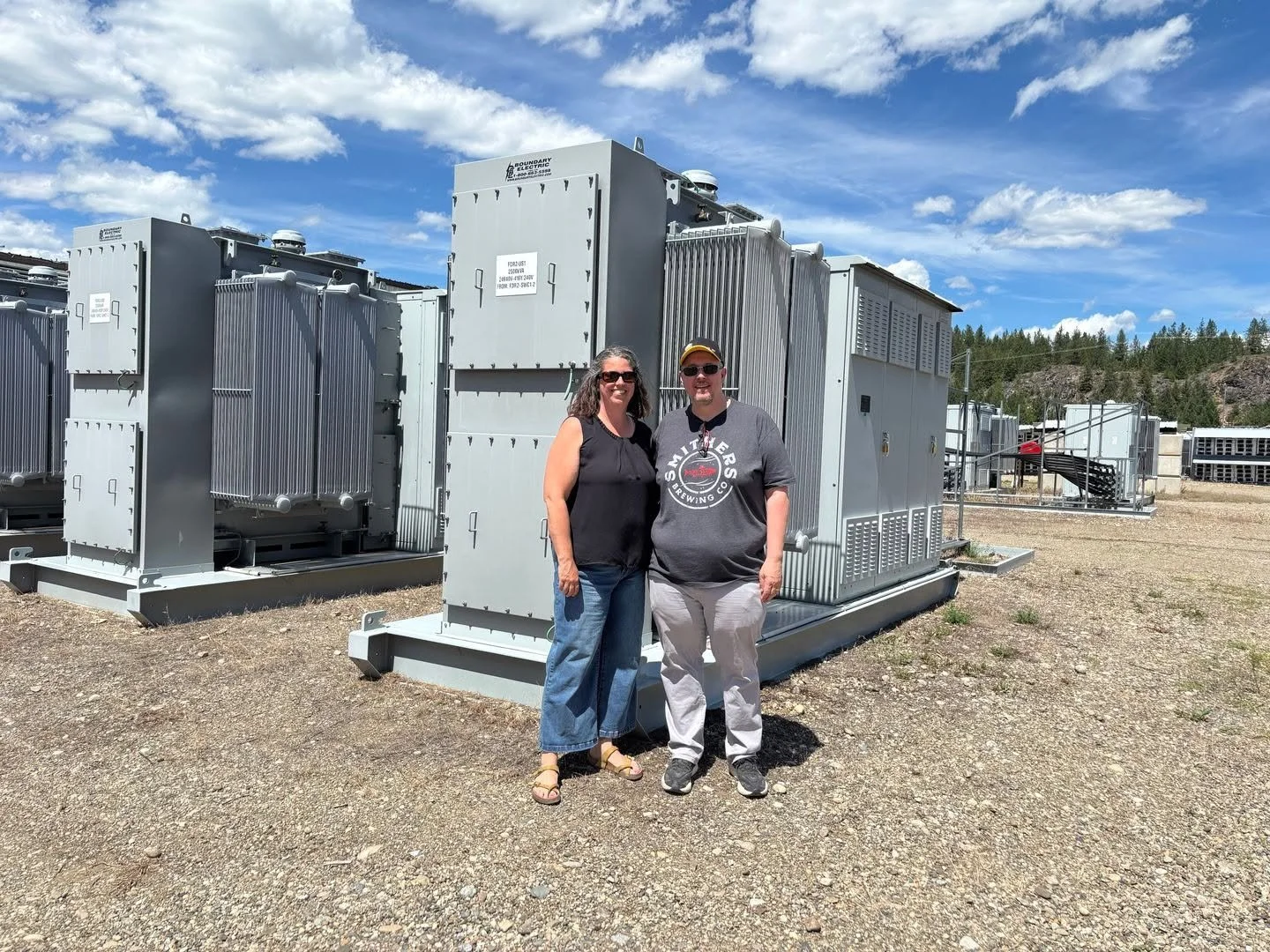
That is why I booked a tour of the facility. Before forming opinions or advocating for policy, I believe it is important to understand the facts firsthand. I also committed to taking the questions raised by residents during my Coffee with the MLA event directly to DMG. Their written responses are attached for anyone who wishes to read them in full.
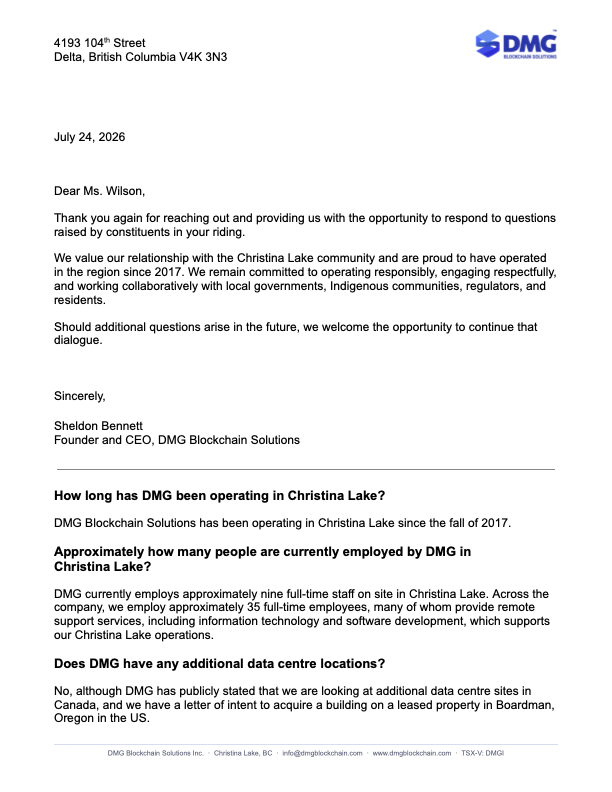
Response from DMG Blockchain Solutions to the questions brought forward by MLA Donegal Wilson on behalf of residents
I also want to share some of my own observations from touring the site.
One of the most common concerns I heard related to water use. After touring the facility, I can confirm that the current cooling system uses a closed, recirculating water system with underground storage tanks. Water is continually reused rather than discharged, and the amount required to top up the system appears minimal and well within the property's licensed water rights.
The company is also modernizing its operation. As older Bitcoin mining equipment is replaced, the facility is being updated to support broader data centre capabilities, with the potential to support future high-performance computing and artificial intelligence applications. At the same time, DMG is transitioning to closed-loop glycol cooling systems that require virtually no water beyond normal domestic use and are substantially quieter than the existing cooling equipment.
I know that noise has been one of the primary concerns raised by nearby residents. During my tour, I was able to compare the existing cooling equipment with the newer glycol cooling systems, and the difference was significant. The newer technology was drastically quieter. Based on what I observed, I would be surprised if neighbouring properties could hear the cooling fans once the site has fully transitioned to the new system. That is certainly something I hope the community will continue to monitor as the upgrades are completed.
In my view, improvements that reduce environmental impacts and noise should be encouraged.
It also became clear that some of the public discussion has been based on the impression that a new data centre is being proposed for Christina Lake. In reality, this facility has been operating in the community for nearly ten years as a bit coin mine and he is just updating the purpose of the computing. From what I observed, the current work is focused on modernizing the existing operation rather than expanding its footprint onto new land.
That does not mean community concerns should be dismissed. They should not. Residents deserve transparency, meaningful engagement, and confidence that their concerns are being addressed. But our conversations must also be grounded in accurate information and an understanding of what is actually being proposed.
The discussion in Christina Lake also highlights a much larger issue that British Columbia has yet to address: digital sovereignty.
Every day, Canadians rely on digital infrastructure. The website you are reading, the social media platform that brought you here, online banking, government services, and increasingly artificial intelligence all depend on data being stored and processed somewhere. Today, much of that infrastructure remains outside Canada's borders.
If Canada wants to strengthen its economic security and compete on the world stage, we need the ability to store, process, and protect more of our digital information here at home. That requires investment in data centres, telecommunications, energy infrastructure, and the skilled workforce to support them.
I was encouraged when the NDP government created a Minister of State for Artificial Intelligence. It signalled that the Province recognized the importance of this emerging sector.
Unfortunately, nearly two years later, there has been little to show for it.
Each time I have raised questions about data centres, artificial intelligence, or the infrastructure needed to support this industry, the response has been that the Province is waiting for the federal government's strategy.
That is not leadership.
British Columbia cannot afford to wait for Ottawa to decide how this industry develops here at home. We do not want decisions about British Columbia's digital future being made by another level of government. Our communities, our electricity system, our natural resources, and our economy are unique. We need a made-in-B.C. strategy.
More importantly, we need integrated planning.
Instead of leaving municipalities and regional districts to deal with proposals one at a time, the Province should be bringing together hydro companies, local governments, industry, environmental experts, and communities to develop a long-term plan. That plan should consider future computing needs, electricity generation and transmission, environmental impacts, water availability, land use, opportunities to recover waste heat, and where these facilities make the most sense.
When those conversations happen together, communities gain certainty, industry has clear expectations, and environmental impacts can be minimized before projects ever reach the approval stage.
As MLA, I will continue pressing the Minister of State for Artificial Intelligence to deliver that provincial framework. At the same time, I believe local governments must continue to have a meaningful voice in deciding whether these facilities are appropriate for their communities and under what conditions they operate.
That is why I encourage the Regional District of Kootenay Boundary and DMG to continue working together to find solutions that reflect the values of Christina Lake while allowing responsible innovation to continue.
My role is not to choose sides. My role is to ensure decisions are based on facts, transparency, and that we develop good public policy that supports all aspects of our economy.
British Columbia cannot afford to ignore the importance of digital infrastructure, but neither can we ignore the legitimate concerns of the communities that host it.
If we get this right, we can strengthen Canada's digital sovereignty, support responsible innovation, protect our environment, and ensure local communities remain active partners in shaping their own future.
That is a conversation worth having—and one I intend to keep pushing forward.